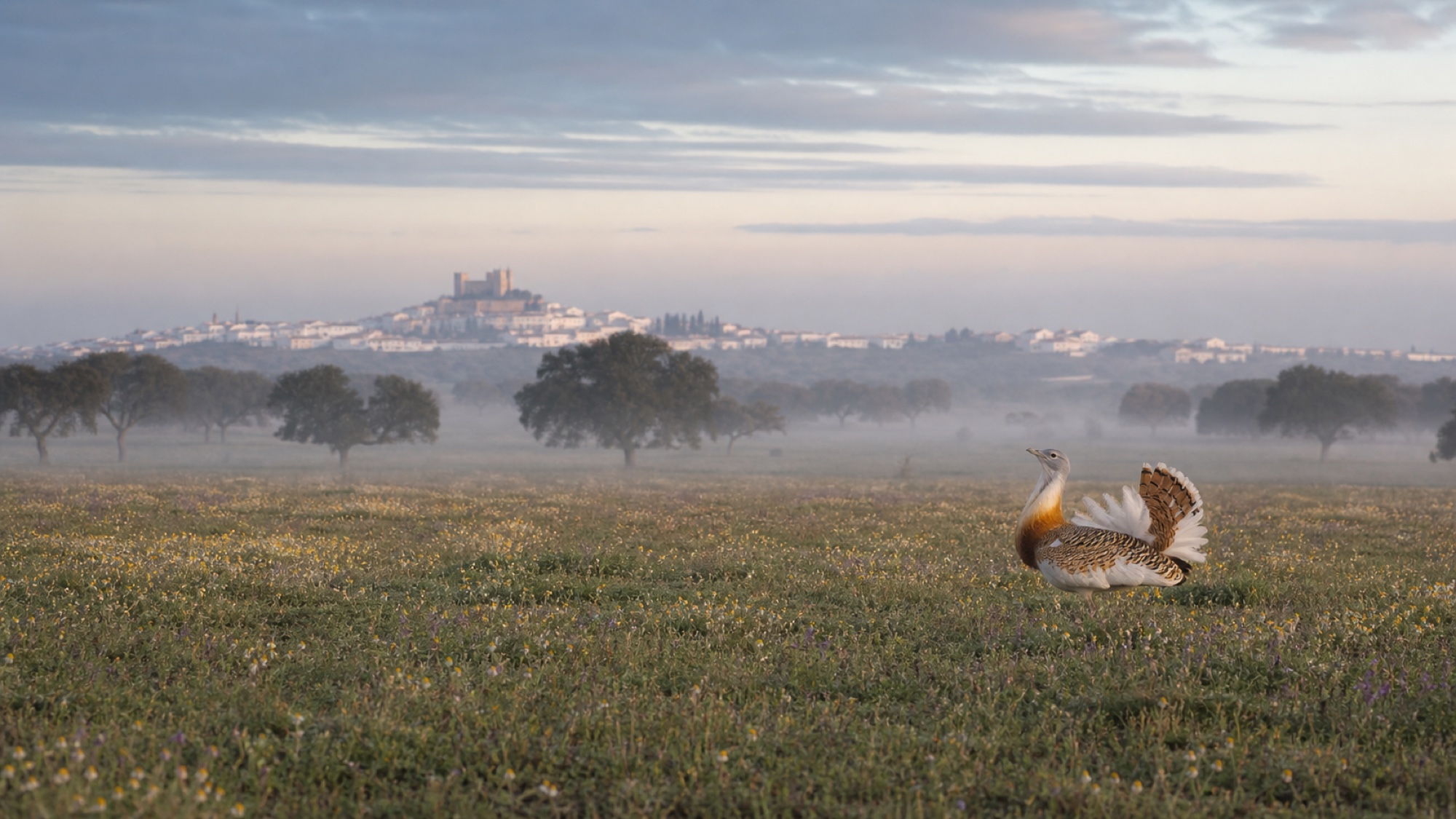
Male Great Bustard displaying on a flower-rich Alentejo plain with a whitewashed Portuguese hill town beyond

Portugal

Portugal — Alentejo, Tagus & the Atlantic

May 2030 · dates are tentative until registration opens · we'll contact you when registration opens11 days / 10 nightsAverage 8 guests · up to 10
register your interest
Great Bustard Otis tardaField recording · dawn

The Journey

Portugal in early May offers the best of both worlds: steppe birds are still displaying, spring migrants have arrived, and the countryside is green with wildflowers before the summer heat sets in. The route begins with two nights in Lisbon, turns east through the Tejo Estuary to Evora, spends three nights in the Alentejo steppe, then follows the south coast from Sagres to Tavira and a Faro departure.

The route · Lisbon → Tejo Estuary → Evora → Castro Verde → Mertola → Sagres → Ria Formosa & Tavira → Faro

Companion guideA Taste of Portugal — food, wine & culinary culture along the routeRead the food guide →

The journey starts with Lisbon’s riverfront and historic quarters, then moves through tidal estuary, inland plains, cork-oak country, Atlantic cliffs and sheltered lagoon. The birding emphasis changes with each move: waders and flamingos first, then bustards and sandgrouse, then raptors, seawatching, salt pan specialists and spring migrants.

Birds and wildlife focus. The Alentejo days concentrate on Great Bustard, Little Bustard, Black-bellied and Pin-tailed Sandgrouse, Calandra and Short-toed Larks, Stone Curlew, Corn Bunting, Lesser Kestrel, Montagu’s Harrier and Iberian Grey Shrike. The Tejo Estuary adds Greater Flamingo, Eurasian Spoonbill, Glossy Ibis, Pied Avocet, Black-winged Stilt, Kentish Plover, herons, Savi’s Warbler and Marsh Harrier, while the Algarve brings Audouin’s Gull, Slender-billed Gull, Caspian and Little Terns, Purple Swamphen, coastal warblers and seabirds. Other wildlife may include Eurasian Otter, Iberian Hare, European Rabbit, Egyptian Mongoose, Mediterranean Chameleon, seahorses in Ria Formosa and Common Dolphin off Sagres.

Culture and landscape. The itinerary threads Lisbon’s Manueline riverfront, Evora’s Roman and medieval core, the cante alentejano country around Beja and Castro Verde, Mertola’s Islamic river-port history, Silves’ Moorish castle, Sagres’ navigator mythology and the working salt pans and old streets of Tavira.

Route map

Tour geography · 11 days

Portugal birding route

Geographic outline · route schematic

NORTHERN MESETASERRA DA ESTRELASOUTHERN MESETAATLANTIC OCEANSPAINBragaPortoCoimbraSantaremSetubalBeja1LisbonDays 1-22Tejo EstuaryDay 3EvoraDay 33Castro VerdeDays 4-6MertolaDay 64SagresDays 7-85Ria FormosaDays 9-106FaroDay 11
1

Days 1-2 · Lisbon

Arrival and Belem base

Two nights on the Tagus riverfront, with a guided Lisbon day through Alfama, Jeronimos and Belem before the route turns inland.
2

Day 3 · Tejo Estuary to Evora

Flamingos, waders and old-town towers

Dawn birding and a boat session in the Tejo wetlands, then a cultural walk through Evora among storks, Lesser Kestrels and Roman stone.

3

Days 4-6 · Alentejo steppes

Castro Verde and Mertola

Two full field days for bustards, sandgrouse, larks and harriers, with a Guadiana gorge raptor watch above Mertola.

4

Days 7-8 · Southwest cape

Sagres and Cape St Vincent

A coastal reset through Silves to Sagres, with a breezy cape watch for seabirds, Bee-eaters and late northbound migrants.

5

Days 9-10 · Eastern Algarve

Ria Formosa and Tavira

Lagoon boat work, salt pans and a flexible second session for gulls, terns, flamingos and Purple Swamphen before the closing dinner.

6

Day 11 · Faro

Wetlands and departure

A final short birding stop near the airport wetlands if flight schedules allow.

Road transferEstuary & lagoonOvernight / field baseMajor city

The line follows the main ground route from Lisbon and the Tejo Estuary into the Alentejo, then south to Sagres, Ria Formosa, Tavira and Faro.

Day by Day

Early-May temperatures are practical planning ranges, not forecasts. Elevations are approximate for the main field or cultural sites each day.

01

Arrive Lisbon

Arrive at Lisbon Airport, where your driver meets the group for the transfer into the city. After settling into the hotel, take an easy evening walk through Belem along the Tagus riverfront, with Belem Tower and the Monument to the Discoveries both close by. Even in the city, watch for Yellow-legged Gulls, Common Terns and wheeling Pallid and Common Swifts; Peregrine Falcons also use Lisbon's taller towers and bridges. Belem Tower, begun in 1515, and nearby Jeronimos Monastery frame Portugal's Age of Discoveries in Manueline stone before the welcome dinner and route briefing.

STAY Lisbon
TARGETS Yellow-legged Gull · Common Tern · Pallid Swift · Common Swift
Typical weatherHigh 21°C / 70°F; low 14°C / 57°F. Mild, mostly dry and shaped by a light Atlantic breeze.
Climate / habitatUrban riverine habitat where the Tagus / Tejo River meets the Atlantic.
AltitudeHistoric Lisbon ranges roughly 0-100 m / 0-330 ft; Belem and Alfama sit near sea level.
02

Lisbon city day

A private licensed guide leads a walking route through Alfama, the oldest district in Lisbon and one of the few neighborhoods to survive the 1755 earthquake, past the Se Cathedral and toward the Belem monuments. Time is built in for the Jeronimos Monastery interior and the original Pasteis de Belem bakery, which has been making its custard tarts since 1837. Rooftops below Castelo de Sao Jorge are good places to scan for Alpine and Pallid Swifts, resident Rock Doves and an occasional Kestrel; a possible detour reaches cooler wooded hills with Firecrest and Short-toed Treecreeper.

STAY Lisbon
TARGETS Alpine Swift · Pallid Swift · Common Kestrel · Firecrest in Sintra
Typical weatherHigh 22°C / 72°F; low 14°C / 57°F. Mild spring conditions with comfortable walking temperatures.
Climate / habitatHistoric urban core across seven hills, with optional cooler forest habitat in the Sintra hills.
Altitude0-100 m / 0-330 ft across the city center.
03

Tejo Estuary to Evora

Leave early with a regional bird specialist for the Tejo Estuary Natural Reserve, a 14,000-hectare wetland of tidal mudflat, saltmarsh, reedbed, rice fields and seasonally flooded pasture. May can still bring hundreds of Greater Flamingos plus Eurasian Spoonbill, Glossy Ibis, Black-tailed Godwit, Pied Avocet, Black-winged Stilt, Kentish Plover, Curlew Sandpiper, Little Egret, Purple Heron, Squacco Heron, Little Bittern, Savi's Warbler, Marsh Harrier and passage Osprey; low tide may also reveal fiddler crabs and a chance of Eurasian Otter. The afternoon continues to UNESCO-listed Evora for the Roman Temple, cathedral and Chapel of Bones, where Lesser Kestrels and White Storks use the old stonework as nesting structure.

STAY Evora
TARGETS Greater Flamingo · Eurasian Spoonbill · Glossy Ibis · Pied Avocet · Purple Heron · Lesser Kestrel
Typical weatherTejo high 21°C / 70°F and low 13°C / 55°F; Evora high 25°C / 77°F and low 13°C / 55°F once inland.
Climate / habitatWestern Europe's largest estuary, shifting from tidal wetland to the warmer Alentejo plateau.
AltitudeTejo Estuary 0-5 m / 0-16 ft; Evora about 309 m / 1,014 ft.
04

Evora to the Alentejo steppes

Transfer into the Campo Branco around Castro Verde and Beja, a UNESCO Biosphere Reserve and Portugal's most important landscape for steppe birds. The habitat is not true wild steppe but a centuries-old cereal pseudo-steppe of wheat, oats, fallow ground and natural grassland, broken by montado where cork and holm oaks are grazed beneath by livestock. An afternoon orientation walk introduces the open horizon required by Great Bustards and sandgrouse, while European Bee-eaters and European Rollers often perch on roadside wires. This is also cante alentejano country, known for unaccompanied polyphonic singing, rustic bread soups, black pork and regional wines.

STAY Castro Verde / Beja area
TARGETS Great Bustard · Little Bustard · Calandra Lark · Lesser Kestrel · European Roller
Typical weatherHigh 26°C / 79°F; low 13°C / 55°F. Cool morning, warm midday sun.
Climate / habitatCampo Branco cereal steppe and montado agroforestry of cork and holm oak.
AltitudeBeja and Castro Verde sit roughly 200-245 m / 660-800 ft on the Baixo Alentejo plain.
05

Castro Verde steppes, day one

A full field day with a local Castro Verde specialist who knows the display leks, sandgrouse flight lines and Lesser Kestrel colonies. Targets include Great Bustard, Little Bustard, Black-bellied and Pin-tailed Sandgrouse, Calandra Lark, Short-toed Lark, Stone Curlew, Corn Bunting, Montagu's Harrier, Hen Harrier and Iberian Grey Shrike. Male Great Bustards, Europe's heaviest flying birds, can exceed 16 kg, while the surrounding rabbit-rich fields help support the raptor community. Iberian Hare and Egyptian Mongoose are also possible along quiet tracks at dawn or dusk. A picnic lunch keeps the group close to the field sites for the best morning and evening light.

STAY Castro Verde / Beja area
NOTE Dawn start
TARGETS Great Bustard · Little Bustard · Pin-tailed Sandgrouse · Montagu's Harrier · Calandra Lark
Typical weatherHigh 26°C / 79°F; low 13°C / 55°F. Bring a warm layer for the dawn start before the plains heat up.
Climate / habitatFarmed cereal pseudo-steppe of wheat, oat fields, fallow ground and natural grassland.
AltitudeAbout 200 m / 660 ft across flat open plains.
06

Castro Verde steppes and Mertola gorges

Return to the steppe for a second pass at missed targets, then move to the Guadiana river gorge near Mertola for an afternoon raptor watch. The shift in habitat is immediate: sheer rock faces and Mediterranean scrub of rockrose, strawberry tree and wild olive replace the flat cereal plains. Spanish Imperial Eagle, Bonelli's Eagle, scarce Golden Eagle, Black Stork, Griffon Vulture, Black Vulture, Peregrine Falcon and Blue Rock Thrush are all possible above the gorge. Mertola itself is a hilltop river town with a castle over the Guadiana and Oeiras confluence, a deep Islamic river-port history, and a church that still preserves the mihrab of its former mosque.

STAY Castro Verde / Beja area
TARGETS Spanish Imperial Eagle · Bonelli's Eagle · Black Stork · Griffon Vulture · Blue Rock Thrush
Typical weatherHigh 26°C / 79°F; low 13°C / 55°F. Warm inland day with cooler morning field conditions.
Climate / habitatSteppe morning followed by Guadiana gorge cliffs and Mediterranean matorral scrub.
AltitudeCastro Verde plains about 200 m / 660 ft; Guadiana gorge near 80 m / 260 ft; Mertola around 220 m / 720 ft.
07

Alentejo to Sagres

A relaxed morning follows the two dawn steppe days before the route turns south from Alentejo plains through the limestone barrocal of the central Algarve. The main cultural stop is Silves, whose red sandstone Moorish castle overlooks the valley from the former Islamic capital of the Algarve, then known as Xelb. The surrounding countryside is still shaped by citrus groves introduced through Moorish agriculture. By evening the group reaches Sagres, where temperatures drop and the wind strengthens on the exposed Atlantic-facing cape.

STAY Sagres
TARGETS European Bee-eater · Eurasian Hoopoe · swifts · coastal migrants
Typical weatherAlentejo high 25°C / 77°F and low 13°C / 55°F; Sagres high 19°C / 66°F and low 14°C / 57°F with cooler Atlantic air.
Climate / habitatInterior montado and Algarve limestone hill country giving way to wind-shaped coastal scrub.
AltitudeSilves about 40-70 m / 130-230 ft; Sagres and Cape St Vincent cliffs about 30-75 m / 100-245 ft.
08

Sagres and Cape St Vincent

Start at Cape St Vincent with a regional specialist guide. Early May is outside the famous autumn raptor peak, but the cape remains active for European Bee-eaters, Alpine Swifts, Sardinian, Subalpine and Dartford Warblers, Blue Rock Thrush, nesting Peregrine Falcons and late northbound movement. Offshore scanning can bring Northern Gannet, Cory's Shearwater or Common Dolphins riding the current off the point. The headland was the Roman Promontorium Sacrum, the sacred cape where the sun seemed to sink into the ocean, and Sagres Fortress and lighthouse still carry the mythology of Prince Henry the Navigator and Portugal's maritime expansion.

STAY Sagres
TARGETS European Bee-eater · Alpine Swift · Dartford Warbler · Northern Gannet · Cory's Shearwater
Typical weatherHigh 19°C / 66°F; low 14°C / 57°F. Coolest and breeziest stretch of the trip, so pack a windbreaker.
Climate / habitatExposed limestone clifftop and wind-pruned coastal scrub in Southwest Alentejo and Vicentine Coast Natural Park.
AltitudeCape St Vincent's cliffs rise roughly 60-75 m / 200-245 ft directly above the Atlantic.
09

Ria Formosa to Tavira

Move east for a boat trip into the Ria Formosa lagoon, a barrier-island system of sandy islands, tidal channels, salt marsh and working salt pans. Birding targets include Greater Flamingo, Slender-billed Gull, Audouin's Gull, Caspian Tern, Little Tern, Sandwich Tern, Black-winged Stilt, Kentish Plover and Purple Swamphen. The lagoon is also known for Mediterranean Chameleon and breeding long-snouted and short-snouted Seahorses in its eelgrass beds. After lunch, walk the Tavira salt pans, where salt has been harvested by hand for centuries, then continue into the Moorish old town and Roman Bridge area for an easy evening stroll.

STAY Tavira / Ria Formosa
TARGETS Slender-billed Gull · Audouin's Gull · Caspian Tern · Purple Swamphen · Kentish Plover
Typical weatherSagres high 19°C / 66°F and low 14°C / 57°F; Tavira high 23°C / 73°F and low 15°C / 59°F, warmer and calmer.
Climate / habitatRamsar-listed barrier-island lagoon, tidal channel, salt marsh and active salt-pan habitat.
AltitudeRia Formosa lagoon and Tavira sit near sea level, roughly 0-5 m / 0-16 ft.
10

Ria Formosa wrap-up / flex day

A flexible final full day lets the group respond to weather, tides and missed targets. Birders can return to Ria Formosa for closer views of Audouin's Gull, Purple Swamphen, flamingos, terns or shorebirds, while a slower cultural option stays around Tavira and Olhao. Olhao's early 20th-century market halls echo North African forms, and Tavira's old town still reflects centuries of Islamic rule before the Christian reconquest of the Algarve. Dinner closes the journey with cataplana, the hinged copper cooking vessel and seafood dish associated with Algarve cuisine.

STAY Tavira / Ria Formosa
TARGETS Greater Flamingo · Purple Swamphen · Audouin's Gull · Little Tern · Iberian Magpie
Typical weatherHigh 23°C / 73°F; low 15°C / 59°F. Warm, bright and generally calmer than the southwest cape.
Climate / habitatSheltered eastern Algarve lagoon and salt-pan system, revisited according to tide and bird activity.
AltitudeSea level, roughly 0-5 m / 0-16 ft.
11

Depart from Faro

If flight times allow, make one short final birding stop near the Faro airport wetlands, an unassuming but productive fringe of the wider Ria Formosa system. It can still produce Purple Swamphen, Black-winged Stilt, Kentish Plover, Greater Flamingo or a passing tern as a final sighting before the transfer to Faro Airport and onward flights.

TARGETS Purple Swamphen · Greater Flamingo · Black-winged Stilt · Kentish Plover
Typical weatherHigh 23°C / 73°F; low 15°C / 59°F. Mild coastal departure conditions.
Climate / habitatCoastal wetland fringe beside Faro Airport, connected to the wider Ria Formosa lagoon.
AltitudeSea level, roughly 0-5 m / 0-16 ft.

Target Species

Great Bustard
Otis tarda
Little Bustard
Tetrax tetrax
Spanish Imperial Eagle
Aquila adalberti
Black-bellied Sandgrouse
Pterocles orientalis
Pin-tailed Sandgrouse
Pterocles alchata
Calandra Lark
Melanocorypha calandra
Lesser Kestrel
Falco naumanni
Greater Flamingo
Phoenicopterus roseus
Purple Swamphen
Porphyrio porphyrio
Audouin's Gull
Ichthyaetus audouinii
Iberian Magpie
Cyanopica cooki
European Bee-eater
Merops apiaster

Where We Stay

Days 1-2
Altis Belem Hotel & Spa
Lisbon riverfront

A 50-room five-star hotel on the Tagus in Belem, close to Belem Tower and the riverfront evening walk; buffet breakfast is expected.

Official lodge site
Days 1-2
Hotel Jeronimos 8
Lisbon alternative

A 65-room design hotel directly by Jeronimos Monastery, useful for groups wanting a smaller Belem base with breakfast included.

Official lodge site
Day 3
Pousada Convento de Evora
Historic center

A 36-room former convent beside Evora's Roman Temple, placing the group inside the old town for the afternoon cultural walk.

Official lodge site
Day 3
Convento do Espinheiro, Historic Hotel & Spa
Evora alternative

A restored 15th-century convent just outside Evora, with gardens and spa facilities for a quieter luxury option.

Official lodge site
Days 4-6
Pousada Convento de Beja
Alentejo base

A 35-room former Franciscan convent in Beja's historic center, about 25-30 minutes from the Castro Verde steppe.

Official lodge site
Days 4-6
Vila Gale Alentejo Vineyards - Clube de Campo
Rural alternative

An 81-room vineyard-estate hotel near Santa Vitoria and Albernoa, with a lake, winery and open countryside setting close to steppe birding.

Official lodge site
Days 7-8
Memmo Baleeira
Sagres cliffs

A contemporary Sagres hotel above the harbour, with Atlantic views and a strong position for Cape St Vincent and southwest-coast field sessions.

Official lodge site
Days 7-8
Mareta View Boutique Bed & Breakfast
Sagres alternative

An 18-room bed and breakfast near Mareta Beach and Sagres Fortress, suited to groups wanting a smaller village base.

Official lodge site
Days 9-10
Pousada Convento de Tavira
Tavira old town

A 36-room former convent close to Tavira Castle and the Roman Bridge, keeping the final evenings walkable in the historic center.

Official lodge site
Days 9-10
Vila Gale Albacora
Ria Formosa alternative

A resort inside Ria Formosa Natural Park, converted from a historic tuna-fishing village with birding possible on and around the grounds.

Official lodge site

Registration

This journey isn't open for registration yet. The full itinerary is set out above; final pricing opens soon. Register your interest below and we'll contact you personally the moment it opens.

What's Included

Accommodation, meals unless otherwise noted, ground transport within Portugal, local guides, park and reserve access, excursions listed in the itinerary, and the services of your Ecotone Journeys leaders.

What's Not Included

International airfare, travel insurance, personal expenses, drinks outside included meals, optional extensions or independent activities, and any single supplement once pricing is published.

register your interest

This journey isn't open for registration yet. Register your interest and we'll contact you personally if a place or a new departure becomes available.