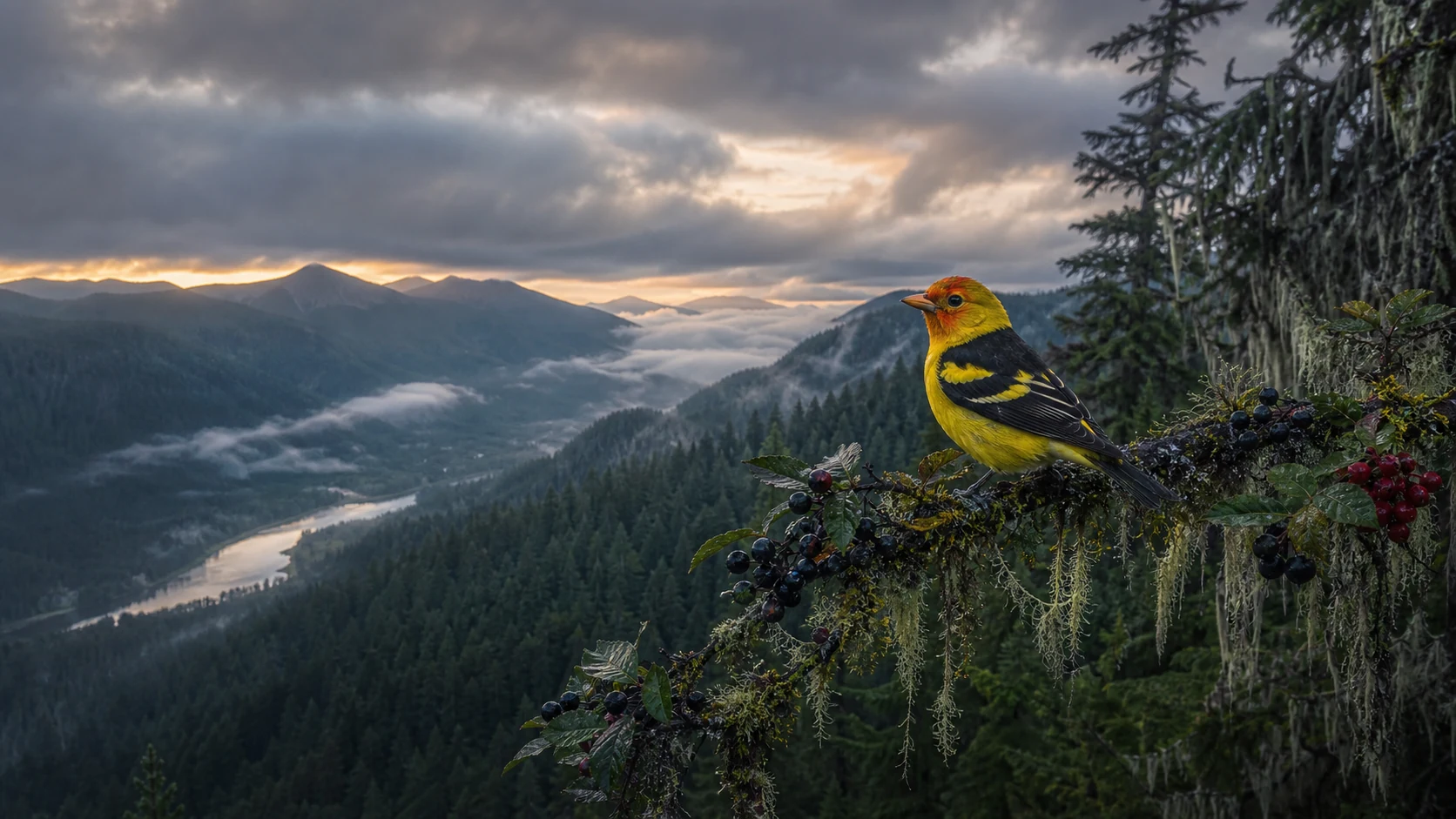
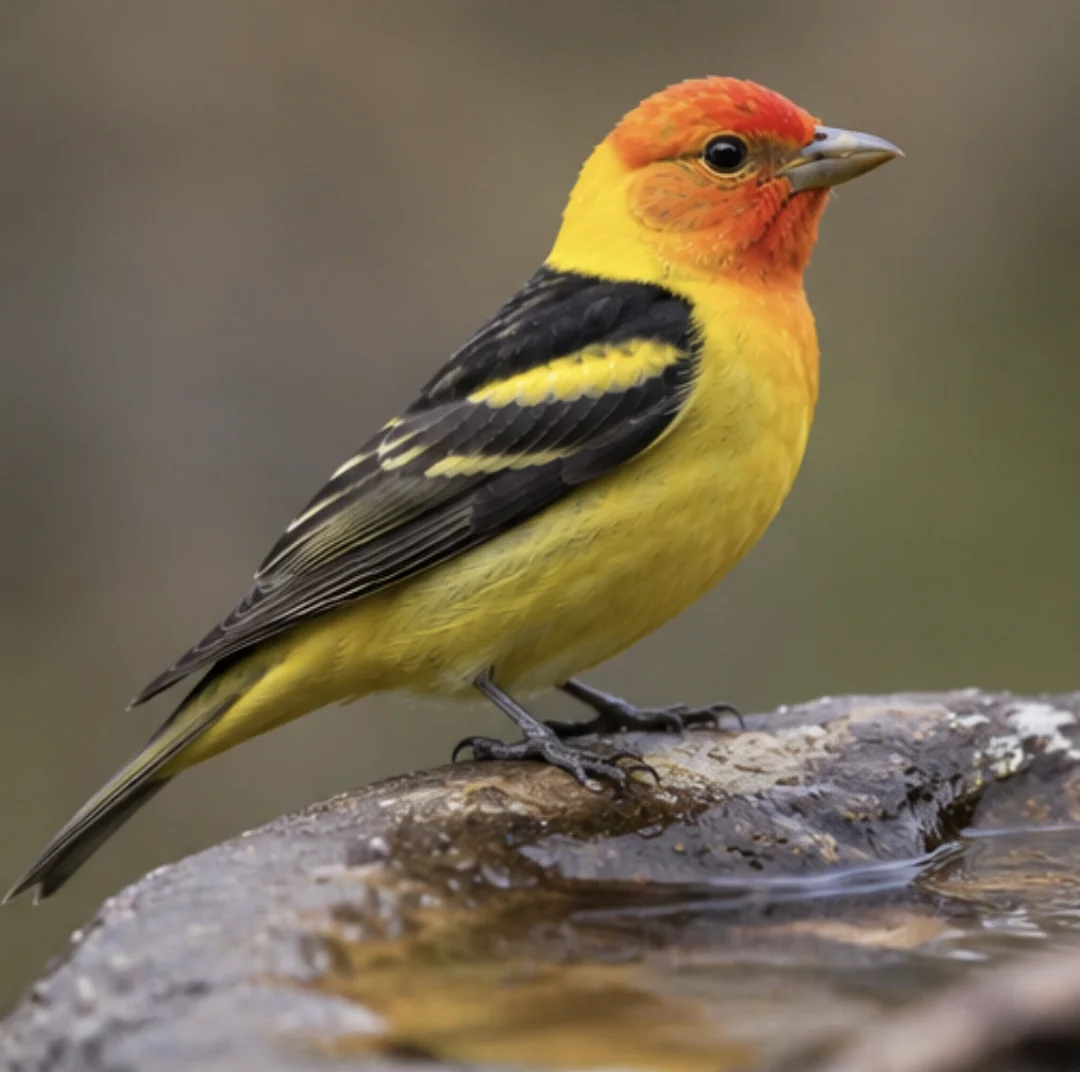
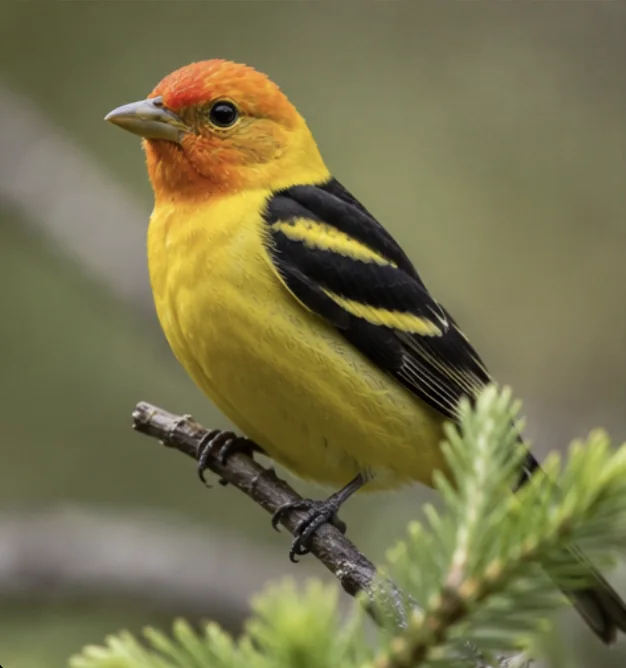
If you live anywhere west of the Rockies and a flash of red-orange and lemon-yellow just dive-bombed your crabapple tree, check the bill before it flies off. If it’s smeared purple-black, that bird has been face-first in fruit — and it’s telling you something real about where we are in the year.
There’s a reason that flash of color grabs people the way it does. Western Tanagers are shy, canopy-loving birds that normally stay hidden in tall conifers, so it’s a small thrill whenever one drops into your fruiting tree — or closer still, to your birdbath. Most people only get that chance during migration, in May or again in August and September. If you’re lucky enough to live near a breeding population, you may see one all summer. Either way, it’s a genuinely wild, remarkably vivid bird choosing to forage close enough to watch from your own porch.
Let’s talk about the Western Tanager (Piranga ludoviciana), and why the stretch from July into fall is when this bird gets interesting.
Dispersal, Not Migration — At First
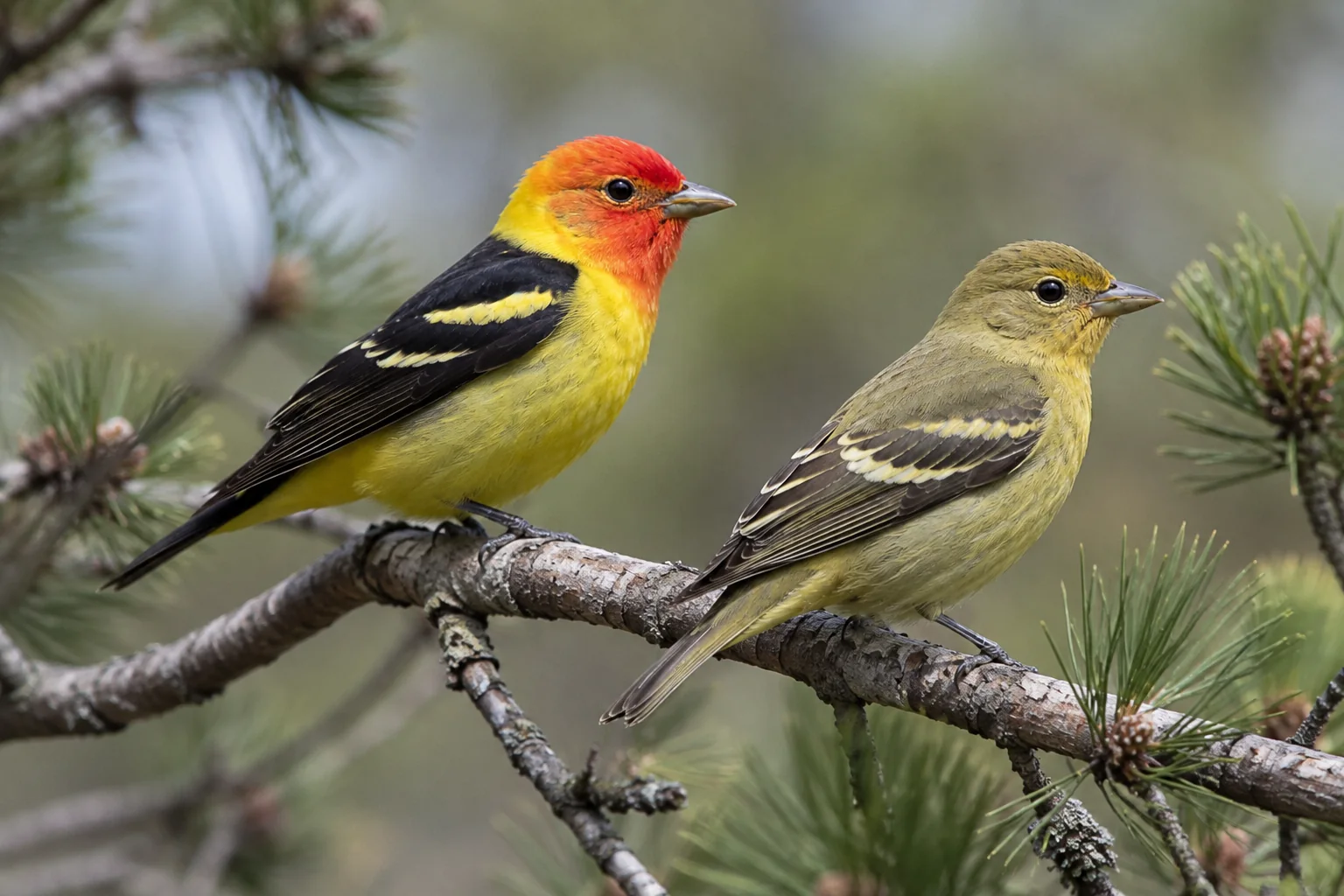
When a tanager appears in your neighborhood looking a little ragged in midsummer, it may not be heading south just yet. It may simply be dispersing after the breeding season.
Migration is the long, directional journey from breeding grounds to wintering grounds, guided by a broad seasonal clock. Dispersal is shorter and less orderly. Adults have finished nesting, juveniles are becoming independent, and birds shift toward whatever they need in the moment — food, water, and cover. A tanager a few miles from where it nested may not have begun its journey to Mexico. It may simply have found a good berry patch.
It’s tempting to picture young birds being led to good foraging ground by their parents, inheriting a bit of local knowledge along with everything else. That’s not really how it works here. Adults tend to leave the breeding area before their own young do — a pattern tied to the age-based molt schedule covered further down — and juveniles have specifically been recorded staying behind on the breeding grounds after the adults have already gone. Whatever a young tanager knows about where to go, it isn’t picking up by following its parents around; the two generations aren’t even in the same place once dispersal starts.
Do adults themselves come back to the same spot year after year? At least one banded male at Rocky Mountain National Park held the same territory three years running, turning up within about 75 meters of his original capture site each time — a nice reminder that a proven spot beats gambling on an unknown one. It’s a real case, not a made-up habit, but it’s still just one bird. Site fidelity is one of several things Birds of the World’s own account admits is still mostly anecdotal for this species, so the honest answer is: it happens, we just don’t know yet how often.
Zoomed out, though, that single bird fits a pattern seen across migratory songbirds generally. Return rates to a known breeding or wintering ground typically run 30–60% year to year in passerines — lower than the 60–90% seen in larger migrants like geese and shorebirds, but still real loyalty, not random wandering. It tends to run stronger in older, more experienced birds, in males more than females, and especially in monogamous species — which tanagers are — since a known site also means a known mate and a proven track record. Where that loyalty falls apart is mid-migration. Stopover sites get far less faithfulness than either end of the trip, and for good reason: a good stopover one year is only useful if it’s still good the next, and a lot can change in between. Weather along the route shifts where a tired bird actually ends up landing. Food supply at a given site can swing with the season or just have a bad year. The site itself can be degraded, developed, or burned since the last pass through. And the bird’s own condition on arrival — how much fat it’s carrying, how urgently it needs to refuel — often matters more than any memory of the place, overriding whatever preference it might otherwise have. Put together, a stopover is judged fresh nearly every time, which lines up with the staging behavior described later in this piece. Nothing about tanagers specifically breaks this mold — they seem to be an ordinary case of a very common songbird habit, not an outlier in either direction.
The Full Timeline: July Through October
Western Tanager migration is protracted, and the Pacific Northwest version breaks down roughly like this:
Begin (mid-July): Failed breeders and birds nesting at the lower-elevation or southern edge of the range can be underway by mid-July — an early trickle, not committed long-distance migration.
Peak (late August–mid-September): The main push builds through August and crests around early-to-mid September, the same window fall-migration birding trips on the Olympic Peninsula are built around, alongside Townsend’s and Black-throated Gray Warblers moving the same corridor.
Gone (by mid-October): The large majority have moved through by early-to-mid October, with occasional stragglers into November.
Put together, you’re watching a rolling handoff from July on: early dispersers giving way to worn post-breeding adults, overlapping with newly independent juveniles, overlapping with true migrants pushing through from farther north. August is simply the month all of them show up in the same berry patch at once.
Same Species, Different Plan: Age and Molt
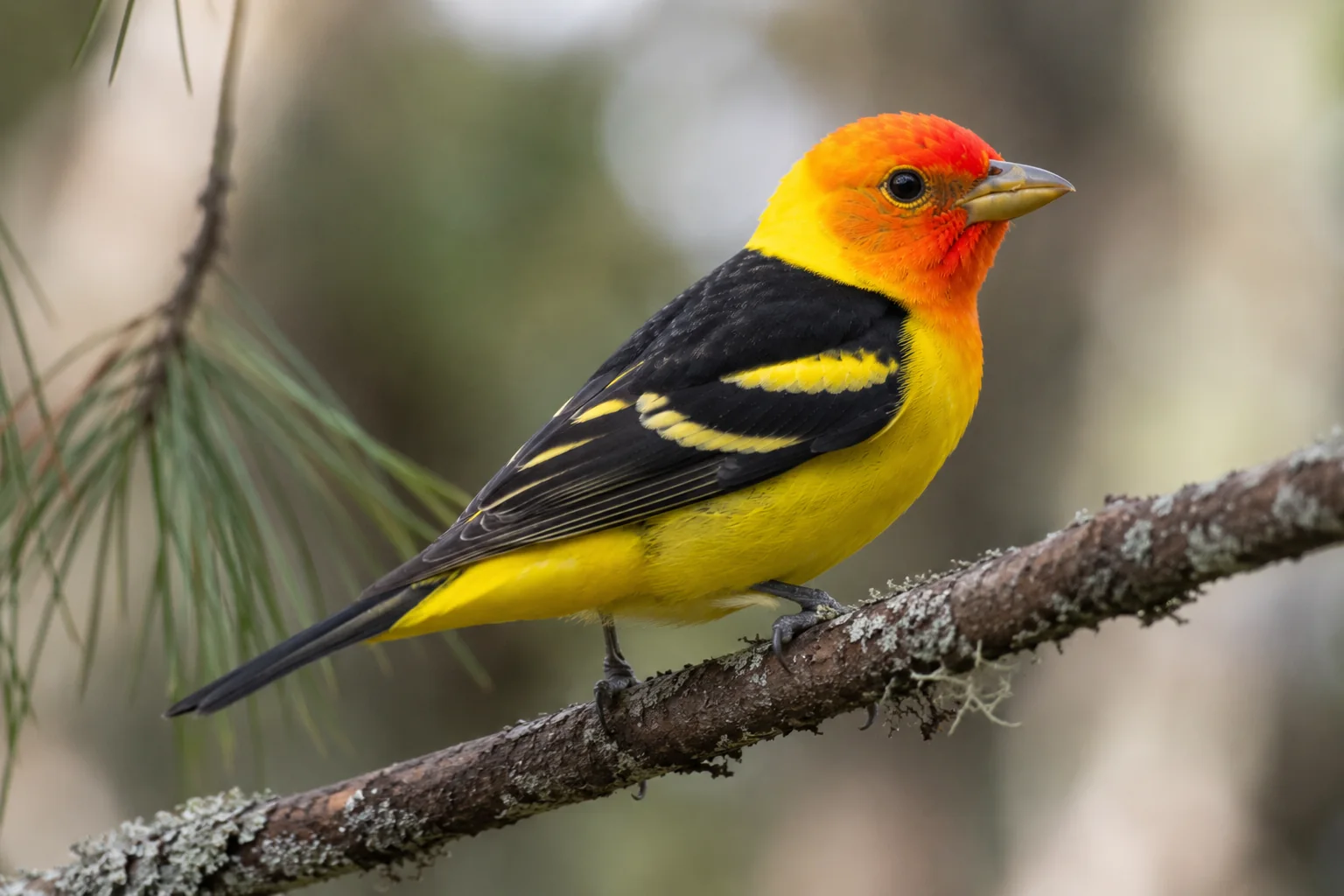
Adults and juveniles don’t just leave at different times — they do genuinely different molts, and the difference shapes almost everything else about how each age group migrates.
Adults undergo one complete molt each year: every feather, body plumage plus both sets of flight feathers — primaries, secondaries, and tail. The unusual part is where it happens. Most adults delay that entire molt until they reach staging grounds in the Southwest or Mexico’s monsoon-fed forests, rather than molting at home first like most songbirds. Juveniles do something different, not just later: they molt their body feathers on the breeding grounds soon after fledging, but keep the same flight feathers they grew as nestlings — those won’t be replaced until their next full molt, a year away. That’s why a young bird looks fresh-plumaged in fall migration while still flying on juvenile wings, and why, in the same berry patch in August, a worn adult is fueling up to migrate toward where it will finally molt, while the cleaner-looking juvenile beside it has already finished molting and simply hasn’t left yet.
Juveniles add one more layer: with no experience of the route, they often make short exploratory movements before committing to any real direction — less “heading south,” more learning the landscape. That’s because migration runs on two different kinds of instruction. One is innate — an inherited internal clock and rough compass that tells a young bird roughly when to leave and roughly which way to fly, sometimes called vector navigation. The other is learned — the specific mental map of landmarks and stopover sites adults build up over repeated trips. A first-year bird has enough hardwired instruction to get the general direction and timing right; the fine details, it works out — or partly stumbles into — on its own first journey.
Where They Come From, Where They Go
Adult tanagers really do stage in Mexico to molt, and this part is well documented: researchers working coastal Sonora and Sinaloa have directly netted molting adults there between roughly July and October, weeks before they continue south. It’s a real stopover — birds arrive, stay, replace their feathers, then move on.
What’s not known is which breeding birds end up where. No geolocator, isotope, or genetic study has traced Pacific Northwest breeders to a specific slice of the wintering range, which runs broadly from Baja California Sur and Sonora down through Central America to Costa Rica. The species is also monotypic — no recognized subspecies, despite breeding across six countries — which hints at weak genetic structure but hasn’t been tested for migratory connectivity. The range as a whole is well mapped; where your backyard’s tanagers specifically winter is still an open question.
Two solid facts stand out for the northernmost breeders, nesting in southeast Alaska and the southern Northwest Territories. First, they have remarkably little time — at that latitude, a tanager may spend as little as two months on the breeding grounds, which, if it arrives in mid-to-late May, points to a departure as early as mid-July, lining up neatly with the early-dispersal window above. Second, their habitat looks different at first glance: this population breeds in lowland riparian corridors rather than the high mountain conifer forest the species uses farther south. That difference turns out to matter for a reason that shows up again below.
Beyond those two points, I’m speculating, and want to flag it as exactly that: a short breeding season might leave these far-northern birds less able to linger at staging sites than birds with more calendar to spare, and a documented bout of unusual wandering into Alaska’s interior and North Slope in one recent summer hints that this population may be more prone to overshoot than the species as a whole. Neither idea is established — they’re reasonable extensions of confirmed facts, not findings.
What Breeding Habitat Looks Like in the Willamette Valley of Oregon
Zoom into the Willamette Valley specifically, and the general habitat rules from earlier get more concrete: the birds show up reliably in mature cottonwood stands along undisturbed river corridors, and in the best-preserved remnants of oak woodland. Once, that habitat covered far more of the valley than it does now — oak savanna and cottonwood gallery forest were reduced to small remnants over the past century-plus of land clearing, and it’s a fair guess that tanagers used to occupy that habitat more broadly across its former extent. What seems to matter for a remaining patch isn’t its size, though — Cornell’s own account of the species notes it doesn’t require large, unbroken forest and actually favors edges over deep interior. What matters is maturity: even a modest remnant works, as long as it still has an older, closed-canopy structure rather than young, open, successional growth. Size shrank; the maturity requirement didn’t.
That’s not really about tanagers specifically — it’s about what an old forest has that a young one doesn’t. A mature stand is layered: canopy, mid-story, and understory, each with different insects and different nest sites. It has large old trees with branch architecture worth nesting in, dead snags that host insects a live tree wouldn’t, and small light gaps from fallen trees that add variety without opening up the whole stand. A young, even-aged stand doesn’t have any of that yet, however green it looks. Research on forest birds generally backs this up: losing that structural complexity has been tied to breeding-habitat decline across most common forest bird species, and in some well-studied cases, actual nesting success — not just whether birds show up — tracks the number of big old trees available. A bird that can feed somewhere but can’t successfully raise young there isn’t really using that habitat in the way that counts.
A bright bird like the tanager also happens to be a good reason for people to notice this kind of habitat at all. It’s not the species most in need of protecting here, but its presence is an easy, visible sign that a stand’s structure is coming back — and that same structure is what quieter, more vulnerable species need to breed successfully too.
Keep the bigger picture in view, though: across its whole range, this species is most common and most closely tied to foothill and mountain conifer forest. Oak and cottonwood are real habitat preferences too, not an afterthought — and because the tanager is so easy to spot and so well loved, its presence has become a familiar, colorful sign of health in regional guidance for oak-habitat restoration. It’s used alongside birds like White-breasted Nuthatch and Western Wood-Pewee — both closely tied to oak habitat — as an indicator of whether a restored oak stand has reached the kind of canopy structure worth calling successful.
That preference for oak and cottonwood isn’t new — it’s likely historical. Western Tanagers seem to concentrate wherever the habitat is most structurally mature, and every general habitat account of this species, across its entire range, lists riparian woodland and oak alongside its core conifer forest as preferred nesting habitat. In southeast Alaska, the same principle likely shows up as the tall river-corridor forest, probably the best-developed forest at that latitude. In the Willamette Valley, what changed is simply the amount of habitat available, not the preference itself: oak savanna once covered far more ground, maintained for thousands of years by regular burning, much of it deliberately set by the Kalapuya people. Fire suppression after Euro-American settlement, plus conversion to agriculture, let conifers and maple encroach on what remained, and the local population using that habitat likely shrank along with it — not because the birds changed what they’ll nest in, but because there’s simply less of it left. The species as a whole isn’t in trouble the way genuine oak-savanna specialists are, though: Breeding Bird Survey data shows Western Tanager numbers actually increasing between 1966 and 2019, since most of the population lives in vast conifer forest across the West, largely untouched by what happened to this one regional habitat.
None of that breeding-season pickiness carries over to migration. During migration, tanagers use an enormously wider range of settings — orchards, city parks, suburban yards, fragmented and marginal patches of trees, isolated street trees, anywhere with cover and something to eat. A tanager passing through in September isn’t evaluating a site the way a breeding pair would; it just needs somewhere safe to refuel for a night or two. Not all yards offer the same odds, though: a patch of native shrubs and trees generally holds far more insects and fruit than an equivalent patch of ornamental, non-native plantings, since native insects mostly evolved to feed on native plants specifically and often can’t use exotic ones at all. A native oak, for comparison, can host several hundred species of caterpillar; a non-native ornamental tree in the same yard might host a small handful. So a tanager passing through a yard full of native plants has genuinely more to work with than one passing through a yard of ornamentals, even if both look equally green from the street. The closed-canopy, structurally-mature standard above is specific to breeding season.
Fruit, Fuel, and the Edge
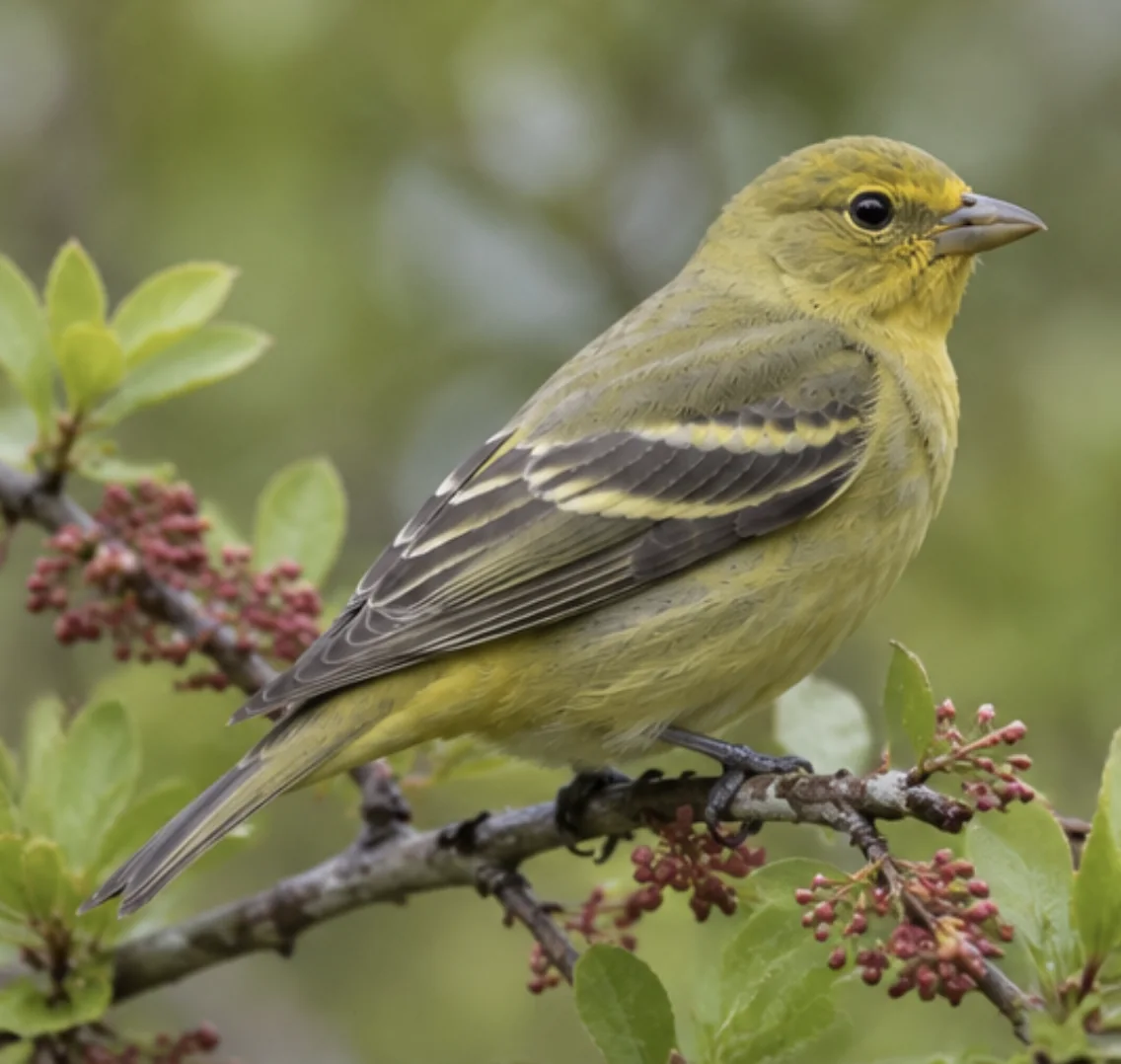
Underneath all of this timing and habitat is a real shift in what a tanager eats, and where it goes to find it.
Through breeding season, the diet is dominated by insects — wasps, ants, beetles, grasshoppers, caterpillars — gleaned off foliage or hawked out of midair. That’s a protein-heavy menu, and building eggs, feeding nestlings, and growing feathers are all protein-expensive jobs. By July, as nesting winds down, fruit works its way in, and by fall it can dominate: hawthorn, wild cherry, blackberry, mulberry, and serviceberry across the range, plus Pacific Northwest specialties — red elderberry (Sambucus racemosa), salmonberry (Rubus spectabilis), Pacific crabapple (Malus fusca), cascara (Frangula purshiana), and huckleberry (Vaccinium spp.) higher in the mountains. The logic is simple physiology: fruit sugar converts quickly into the fat an overnight flight burns through, while insects cost more effort per calorie returned. The actual mechanism has a name — de novo lipogenesis, the process by which the liver converts dietary sugars like glucose and fructose directly into fat. It’s the same pathway that lets a bird go from a berry patch to a usable fuel tank in days rather than weeks, and it’s well documented across fruit-eating migratory songbirds generally, not just this species. Insects don’t disappear from the diet, but the center of gravity shifts toward fruit all the way to the wintering grounds.
Where that fruit actually grows thickest is no accident either. By midsummer, interior forest dries out and insects thin, so tanagers move toward whatever’s still wet — creeks, springs, wetlands, rivers — where insects keep hatching and understory fruits ripen hardest. This is the ecotone again: the richest late-summer feeding isn’t deep in the woods or out in open field, but in the damp, shrubby seam between them, ripening in an overlapping sequence through the back half of summer. A tanager hopscotches between patches, tracking whichever shrub is peaking.
Birds have depended on these fruiting landscapes since long before field guides gave them names. Salmonberry and huckleberry in particular have been gathered by Indigenous peoples of the Pacific Northwest for thousands of years — harvested fresh and dried, and still part of traditional foodways today. Seeing a tanager feed there is a reminder that these plant communities sustain many kinds of relationships, including human ones rooted in knowledge, harvest, and care.
Staging: Why the Pace Feels Slow
Once true migration starts, it happens almost entirely at night, in discrete flights followed by days of rest and refueling. Banding data from Sweden — on European songbirds, not this species specifically, but the best real-world measurement of this kind available — gives a sense of scale: among birds recovered within a week of ringing, the median distance covered per flight stage was about 245 km (roughly 150 miles), with real spread — some birds clearly flew several nights running, others barely moved, likely still hunting for a good stopover.
Which nights those flights happen on tracks the weather closely. The best nights come right after a cold front passes: skies clear, high pressure builds in, and the wind swings around to blow from behind — a tailwind that can let a bird cover twice the distance for the same effort. Those are the nights a staging tanager, with enough fat banked, actually launches. The bad nights are the mirror image: low pressure, headwinds, rain, unstable air — all of which make flying expensive and disorienting, so birds stay put and keep feeding instead. That’s the real mechanic behind staging: it isn’t idle waiting, it’s refueling through the bad-weather stretch while watching for the next good-weather window, then cashing in the fat reserve the moment conditions turn.
That’s also why fall migration feels unhurried compared to spring. There’s no reason to rush while a berry patch keeps delivering and the weather holds, so birds linger for as long as conditions stay good and move on when the patch thins or a cold front makes leaving easy. A tanager parked in a productive shrub isn’t behind schedule. It’s on the only schedule this species keeps.
What Banding Tells Us
Almost everything above traces back to one source: bird banding, run continuously across North America for more than a century. A recovery means someone other than the original bander later finds the bird, often dead. A return means a bander recaptures it alive, usually near the original site in a later season — confirming both survival and location.
Western Tanagers have their own entry in that record: the oldest one documented was banded in Nevada in 1965 and recaptured alive in Oregon in 1971, at least six years and eleven months old. That single recapture set a longevity record and confirmed the same individual can turn up in a different state years later, still going about its business. Every backyard sighting logged with a date and location adds a smaller version of that same kind of data.
The Few That Stay
A small number of Western Tanagers don’t leave the Pacific Northwest at all. The high point was winter 2022–23, when eleven were logged region-wide — an explicit seasonal record. Since then, the numbers look to have fallen rather than kept climbing: Seattle’s own Christmas Bird Count, run the same way in the same area every year, went from a marginal presence in 2022 to two consecutive misses in 2024 and 2025. So this looks like a real peak-and-decline, not a steady rise.
California tells a different story worth setting alongside it. Statewide Christmas Bird Count totals for Western Tanager climbed from 54 in winter 2021–22 to 117 by winter 2023–24, and San Diego’s single-count high of 21 that same year matched a number last reached in 1981 — suggesting California’s increase is real and still building, rather than a one-off peak like the Pacific Northwest’s.
It’s tempting to call overwintering a clever shortcut — migration is a genuinely dangerous stretch of a bird’s year, and skipping it avoids real risk. Ecologists have a term for range-level versions of this, “short-stopping,” though it comes mainly from studying geese and swans, so applying it here is an analogy, not an established finding for this species. It’s equally possible a tanager still in Washington in December is injured or simply couldn’t complete the trip, and staying carries its own risk: one hard cold snap can wipe out the fruit and insects it depends on, with none of the backup a bird in Oaxaca has. Which explanation fits which bird isn’t something the data can answer yet — which is exactly why a documented winter sighting, logged with date, location, and a photo, is worth something real.
What You Can Actually Do With This
- Leave the “messy” fruiting shrubs alone, especially near water. An unkempt hedge in August is prime real estate for a tired adult or a wandering juvenile.
- Log what you see in eBird — a stained bill with a date and location becomes a small data point in the same kind of picture this article draws on.
- Report a banded bird at reportband.gov if you find one, alive or dead.
- Watch, don’t crowd. A molting or newly independent bird is more vulnerable than usual; enjoy it from a respectful distance.
Enjoyment, conservation, and familiarity aren’t separate things here — they’re the same thing from different angles. The more familiar you get with what a berry-stained bill actually means, the more that ordinary backyard moment turns into something worth protecting: the water, the shrubs, the whole scruffy edge that made it possible.
Ecotone Journeys Newsletter article, 2026 — Authorship and AI disclosure. This article was compiled and authored by Dan van den Broek, with AI used as a co-authoring and research tool. Portions of the text were generated using artificial intelligence and reviewed for accuracy by the author and human research assistants. AI also assisted with research and drafting; Dan van den Broek remained responsible for the final writing, fact-checking, editorial judgment, and publication.
Further Reading
- Western Tanager species account — Cornell Lab All About Birds
- Western Tanager life history — Cornell Lab All About Birds
- Diet and Foraging — Western Tanager, Birds of the World
- Movement and Migration — Western Tanager, Birds of the World
- Oak Bird Guide: Bird Habitat and Populations in Oak Ecosystems — American Bird Conservancy
- Summary of Bird Survey and Banding Results at W.L. Finley National Wildlife Refuge, 1998–2008 — USGS
- The New Birds of Winter — Cornell Lab All About Birds
- Interpreting seasonal range shifts in migratory birds: a critical assessment of “short-stopping” — Journal of Ornithology
- Postbreeding elevational movements of western songbirds — Ecology and Evolution (open access)
- Pre-migratory flights in migrant songbirds — Movement Ecology (open access)
- Overlap of Molt and Fall Migration of the Western Tanager and Warbling Vireo in Southern California — Western Birds
- Temporal, Spatial, and Annual Variation in the Occurrence of Molt-Migrant Passerines in the Mexican Monsoon Region — Pyle et al., 2009
- Butler, Donahue & Rohwer (2002), “Molt-Migration in Western Tanagers” — The Auk
- Evolution of winter molting strategies in European and North American migratory passerines — PMC
- How far do birds fly during one migratory flight stage? — Ringing & Migration (Hall-Karlsson & Fransson, 2008)
- Understanding birds & weather: Fall birding basics — eBird
- Associations of Synoptic Weather Conditions With Nocturnal Bird Migration Over the North Sea — Frontiers in Ecology and Evolution
- North American Bird Banding Program longevity records — USGS
- The genetics and epigenetics of animal migration and orientation — Journal of Experimental Biology
- Revisiting Perdeck’s massive avian migration experiments — Biology Letters
Until the next journey—from the edge,
Ecotone Journeys